
Indian pharmaceutical companies are not rushing to relocate manufacturing to the United States despite former President Donald Trump's renewed threat of tariffs up to 200 per cent on imported generic drugs. Instead, they are leveraging existing US plants, contract manufacturers, and making selective investments in complex products while maintaining India as their primary production hub.

US President Donald Trump announced steep tariffs on imported generic medicines, effective from August 2028, with the aim of boosting domestic pharmaceutical production. This policy, which includes a phased increase in tariffs up to 200 per cent, could significantly impact India, a major global supplier of generic drugs to the US market.

Indian pharmaceutical companies are strategically increasing investments in the US market, focusing on specialty drugs, complex generics, respiratory products, and local manufacturing, despite a nearly 10 per cent fall in exports to the US in FY26 due to pricing pressure and competition in traditional generics.

Indian foreign direct investment (FDI) in the United States has reached approximately USD 16.4 billion, supporting around 70,800 jobs and contributing significantly to research and development, according to US Deputy Undersecretary Brandon Remington.

'Infertility and reproductive health challenges, much like other chronic conditions, are rising globally.'

Pharmaceutical major Cipla reported a 3 per cent year-on-year decline in March quarter revenue to Rs 6,541 crore, with net profit falling 55 per cent to Rs 554.6 crore, missing consensus estimates. Despite strong growth in India and Africa, a significant decline in North American sales impacted overall performance, with the company now focusing on new product launches and regulatory filings to drive future gains.

'The unregulated marketing has to stop. People are getting recommendations for this from gym trainers, from marriage counsellors -- that is simply unacceptable.' ''There are many ways to lose weight -- eat less, fast, exercise, eat healthy. That is how you lose weight.'

As the potential threat of a steep 200 per cent tariff on pharmaceutical imports hangs in the air, analysts and industry insiders feel that focus on exports to non-US regions as well as domestic market will increase as a long-term trend. US President Donald Trump told CNBC's Squawk Box in the first week of August that planned tariffs on import of pharmaceutical products to the US could eventually reach up to 250 per cent.

With Donald Trump all set to become US president, Indian exporters may face high customs duties for goods like automobiles, textiles and pharmaceuticals if the new US administration decides to pursue the 'America First' agenda, opined trade experts. Experts also said that Trump could also tighten H-1B visa rules, impacting costs and growth for Indian IT firms. Over 80 per cent of India's IT export earnings come from the US, making it vulnerable to changes in visa policies.

Representatives Deborah Ross of North Carolina, Marc Veasey of Texas and Raja Krishnamoorthi of Illinois introduced the resolution on Friday in the House of Representatives to terminate Trump's national emergency authorising tariffs of up to 50 per cent on imports from India, helping to restore Congress' constitutional authority over trade.
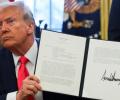
Industry insiders in India warn that any such move in the pharmaceutical sector could be counterproductive for the US as it may face increased drug shortages if tariffs are imposed on such imports.
Trump may temper his approach from time to time, but to think that he will change his basic philosophy is delusional, asserts T T Ram Mohan.

From the Sensex pack, Tata Consultancy Services, HCL Technologies, Tech Mahindra, Infosys, Tata Motors, Bajaj Finance, Kotak Mahindra Bank, Mahindra & Mahindra, Bharti Airtel and Maruti Suzuki India, Tata Steel were the major laggards. PowerGrid, Sun Pharmaceuticals, UltraTech Cement, NTPC, Asian Paints, Nestle India, Titan, IndusInd Bank and Axis Bank were among the gainers.

Pharmaceutical companies in the country offering any financial incentive to doctors to prescribe particular drugs may become a thing of the past if the drug manufacturers decide to follow the strict code of conduct being implemented by a US industry trade group.
The PhRMA's observation is significant against the backdrop of Swiss pharma major Novartis AG's decision to relocate its R&D investments from India.

A fresh US executive order (EO) which seeks to bring down prices of prescription drugs in the country by up to 90 per cent -- on par with other developed nations -- will affect innovator companies, while sparing the Indian generic drug makers in the short term. US President Donald Trump signed the EO on Monday, directing the US Trade Representative and the Secretary of Commerce to act against foreign countries that "purposefully and unfairly undercut market prices", driving price hikes in the US.

'As the global economy undergoes significant transformations in 2025, India's ability to navigate the complexities of trade wars, financial realignments, and emerging blocs will be pivotal,' explain Harsh V Pant and Soumya Bhowmik.

After Chennai, it is Coimbatore, Madurai, and Tiruchirappalli, that are emerging as manufacturing hubs. Coimbatore is India's top Tier-II city in terms of the number of GCCs, according to a report by Cushman & Wakefield.

Washington-based Pharmaceutical Research and Manufacturers of America (PhRMA), the representative body of US-based drug firms, has said it does not support the seizure of legitimate generic medicines meant for developing country destinations.

The US pharma industry has expressed concern over deteriorating intellectual property environment in India, alleging that patent rights in the country are unreasonably denied.The US pharma industry has expressed concern over deteriorating intellectual property environment in India, alleging that patent rights in the country are unreasonably denied.
Based on information from 10 pharmaceutical companies based in North America and Europe, a recent Jones Lang LaSalle Meghraj report said these were keen to set up their manufacturing units in India or expand their existing units. Taken together, these would need about 15,000 acres over the next seven years to set up research and development centres, new units and to expand the existing units.

Next week, US Secretary of State John Kerry travels to India for the fourth annual US-India Strategic Dialogue

Communications between the USTR and the world's most powerful pharmaceutical and trade lobbying groups reveal that many raised concerns about India's push to exempt Covid vaccines from intellectual property.

India's IPR framework and enforcement were comparable to those in developed countries

As its factories resumed operations after over two-month of grim battle against coronavirus, China is busy tapping into the vast business opportunities of export of key medical goods, specially ventilators and personal protection equipment (PPE), across the world, including India, where both private and government bodies are placing orders for the import of these products.

The unilateral pressure by US administration on India, at the behest of US Business Associations lobby through US International Trade Commission investigations and request to USTR to enlist India under Priority Foreign Country under Special 301 review, lacks legitimacy under WTO framework, the signatories to the letter said.

Whistle-blower Dinesh Thakur will speak on Made-in-India drugs at an event in Washington.

Sun Pharma to retain these in most markets; US could be the exception, where the Ranbaxy name has taken a hit.

Amneal Pharmaceuticals is set to pip Sun Pharma as the fifth largest generics maker in the US, reports Sohini Das.

Data also show that several other leading domestic pharma companies have recalled their products from the US

An alert government in Delhi should have begun government-to-government discussions with Moscow the moment it came to know that Russians were developing a vaccine. That is to say, almost an year's time has been lost, observes Ambassador M K Bhadrakumar.

As part of the charm offensive, New Delhi has invited global regulators -- including the FDA -- to visit Indian production units to get first-hand evidence of measures taken to ensure the quality of locally manufactured generics.

Currently, Himalaya sells 250 products across the globe.

India has been pursuing measures that discriminate against overseas businesses, says US Congressman Erik Paulsen.

Amid subdued demand for traditional information technology (IT) services offerings, Indian IT services players are betting on big data, as this is high on clients' agenda.

High growth is also much easier to log in a small business than in a Reliance.

Bharat Biotech started work on developing a vaccine against Zika way back in 2014.

Analysts now expect India Inc to report a decline in both top line and bottom line for the September quarter.

The 30-share Sensex ended down 30.30 points at 28,161.72 and the 50-share Nifty dipped 7.95 points at 8,543.

Minister for External Affairs Salman Khurshid speaks about the importance of the fourth edition of the India-US Strategic Dialogue, which he co-chaired with United States Secretary of State John Kerry in New Delhi
